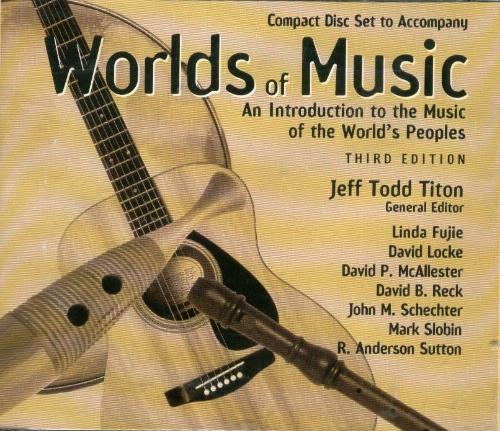
Veena player Ramachandra Iyer (see here) was in his seventies when he recorded "Sarasiruha," which is featured in the academic compilation Worlds of Music pictured above. This is South Indian (Carnatic) classical music, which begins with an alap (improvisation), becomes more rhythmic, then moves to the kriti (set composition where the drums kick in), and the pallavi and anupallavi, developments of the kriti.
Something like that, at least. Check here for better details.
Listening to this piece in an ethnomusicology class at SUNY Binghamton in the '90s was an awesome experience for me. You can even hear a dog barking in the background of the recording, so you know this is the real deal.
The veena has more of an earthy sound than sitar. Here, it is a thing of beauty. You will be transported to another place. Also check out the work of Chitti Babu, E. Gayathri, and other Carnatic musicians on Spotify and YouTube.
For instrumental favs in other styles, click here for one of my prior posts.
I saw part of this video on Family Guy and thought it a good day to share. I had some Easter-related music to post yesterday, but my nephew was born, so I put that on hold. I'll post more soon.
Meanwhile, let me point to something my friend Paul shared with me, Howard Goodall's Story of Music. I have to watch these. Paul has an excellent blog as well, being British and living in Florida - see here.
All the surviving Germanic languages today are either from the West Germanic branch, including English, Frisian, Dutch, and German; or the North Germanic, Scandinavian ones. The Eastern branch died out a long time ago, and the only substantial extant manuscript we have of that family of languages is a Gothic translation of portions of the Bible by Ulfilas. It amazes me how one tenuous thread can open such a fascinating and comparatively wide door to linguistic history.
Ulfilas, or Wulfila, made his own alphabet for the translation, the letters drawing heavily from Greek and Roman. The photograph above comes from Robert Pfeffer's very excellent site (in German and English), which has historical information as well as mythological art. In this Youtube video, Pfeffer does an absolutely fascinating job pronouncing a passage from the Gospel of Luke:
What amazes me how un-Germanic it sounds, at least at first, but then you pick up on certain words that look similar to words in modern German or English. (Incidentally, I left a comment in German on the video, or at least I tried.) Though we can't be sure what the language really sounded like, to me this is as convincing as it gets.
Take a look also at this lesson from Alexander Arguelles's excellent YouTube series on modern and extinct languages:
As you listen to his translation of the text above, you'll see some connections. Let me give one more example of Gothic - the Our Father, in this case using Roman characters and a thorn (þ) for the th sound:
Atta unsar þu in himinam,
weihnai namo þein,
quimai þiudinassus þeins,
wairþai wilja þeins,
swe in himina jah ana airþai.
hlaif unsarana þana sinteinan gib uns himma daga,
jah aflet uns þatei skulans sijaima,
swaswe jah weis afletam þaim skulam unsaraim,
jah ni briggais uns in fraistubnjai,
ak lausei uns af þamma ubilin. Amen.
Just looking at the first line, we see atta = father; unsar = unser (our in German); himinam = Himmel (heaven). The second line: weihnai = holy (so Fröhliche Weihnachten, which is Merry Christmas in German, literally means something akin to "Happy Holy Night"); namo = name; þein = thy, thine. Then a few lines down, daga = day.
And so on. What we'll likely not fully know is what these people did for fun, what they ate, what music or art they might have created, what their society was like. But the idea that a Germanic culture existed down near the Mediterranean region back in the 4th Century, and that they spoke a language related to ours, however distantly, shows us a significant link in a long chain that extends even farther back to places we can only imagine.
Cheers,
Angus
P.S.: Robert pointed a a great series by BenJamin P. Johnson, "Gothic for Goths." The first video begins with the alphabet: